
360 Litre Commercial Bin Hire
The largest two-wheeled bin: extra room for light, bulky recycling where a four-wheeled container cannot be stored or moved.
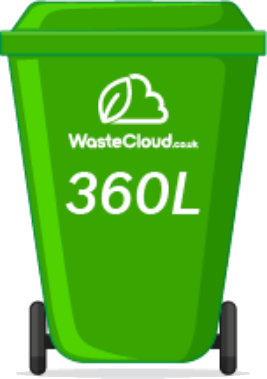
Between the everyday 240 and the four-wheeled 660 sits a bin that solves a particular problem. The 360 litre bin gives half as much capacity again as a 240 while keeping two wheels and a tip-and-pull action, so it can still be taken down a side passage, over a door threshold or across a cobbled yard that would defeat a four-wheeled container. It is a noticeably bigger bin than the 240, and it is at its best with waste that takes up room without weighing much.
We arrange 360 litre bins through licensed local partners, and not every partner offers the size on every stream, so availability is checked against your postcode. Recycling is the usual use: cans, plastic bottles, paper and flattened card from offices, schools, gyms and small retail units. See commercial wheelie bin hire for the complete range.
Light and bulky is the brief
Empty drinks bottles, crisp boxes, shredded paper and packaging film fill a bin long before they make it heavy. That is the material a 360 handles well, and it is why the size is most often supplied for mixed recycling and cardboard. Dense waste is another story. A 360 loaded with glass or food would be hard for one person to control on a slope and may exceed what the collection vehicle is permitted to lift, so partners commonly restrict those streams to smaller bins. If your waste is mostly heavy, tell us and we will suggest a different combination instead of a bigger container.
Premises that suit a 360
Typical users are businesses that have outgrown a 240 but have nowhere level to keep a four-wheeled bin. Think of a first-floor office with a shared ground-floor bin store, a village shop with a gravel yard, a sports club where bins are wheeled across grass to the car park, or a terrace of small units with a stepped rear lane. Schools and nurseries often place them near classrooms and canteens as recycling points. Compared with two 240s, a single 360 also occupies less wall length, which helps where bin stores are shared between tenants and every space is accounted for. Agents booking for several tenants can read more under property management.
Getting collections right
As with any bin, the lid must shut and nothing should be stacked alongside. Recycling loads are checked, formally or informally, when the bin is tipped, and one black bag of food-soiled rubbish can cause a whole load to be rejected or charged as general waste. Clear labels and a short briefing for staff and cleaners prevent most problems. Frequency is agreed when the service is set up and can be altered later; details are on the scheduled bin collections page. Remember that separation requirements for recyclables and food differ between England, Scotland and Wales, and we confirm which apply to your site.
Stepping up to four wheels or beyond
If the ground is flat and a collection vehicle can get reasonably close, a 660 litre bin is normally a better answer than a pair of 360s. Larger producers move on to the 1100. Where cardboard and packaging arrive by the pallet load, as they do in warehouses and distribution units, wheelie bins of any size become a daily chore and it is worth considering a dedicated cardboard collection of bales or cages, or a RORO container for cardboard and packaging. Tell us roughly how much you produce in a week and we will say honestly whether bins are still the right tool.
Well suited to a 360 litre bin
- Plastic bottles, pots and tubs
- Drinks cans and food tins
- Office paper, newspapers and magazines
- Flattened cardboard boxes
- Light bagged general waste, where offered
Poorly suited or not permitted
- Glass in quantity (use smaller dedicated bins)
- Food waste
- Rubble, soil and ceramics
- Electrical items and batteries
- Polystyrene and food-soiled packaging in a recycling stream
- Liquids of any kind
Not sure? See our waste types guide or ask us when you book.
Ideal for
- Upper-floor offices
- Village and corner shops
- Sports clubs and gyms
- Schools and nurseries
- Shared bin stores
- Sites with gravel or stepped access
360 Litre Bins – your questions answered
Can’t see your question? Call 0333 121 1056 or send us a message.
What is the difference between a 360 and a 660 litre bin?
Apart from capacity, the main difference is how they move. A 360 has two wheels and is tipped back and pulled, so it copes with rougher ground. A 660 has four castors and is pushed upright, which needs a hard, level surface.
Can general waste go in a 360 litre bin?
Some local partners offer the 360 for general waste and others keep it for recycling streams only. Where it is offered, it suits light bagged waste; dense general waste makes a bin this size hard to handle. We confirm the options for your postcode.
Will a 360 litre bin fit where my 240 stands now?
Not necessarily, as it has a larger footprint and a wider lid. We do not publish measurements because bins vary by manufacturer; the local partner can confirm the size of the model they supply so you can check your bin store before delivery.
Is the 360 litre size available everywhere?
No. It is less widely stocked than the 240 and 1100, and some rounds do not lift it at all. We check against your postcode and, if it is not available, suggest the nearest practical alternative.
Often booked with 360 Litre Bins
Need more than one service for the same project? Add them to one enquiry and we’ll coordinate them together.
Get a Quick Quote
Tell us the site postcode, the waste, the container size if you know it, and when you need it. Mention exchanges, other sites or specialist waste and we will include them. Photos of the waste and the access help.
ROROSkipHire.com is operated by Waste Cloud Ltd. Services are coordinated centrally and carried out by licensed local waste management and haulage partners across England, Scotland and Wales.