
660 Litre Four-Wheeled Bin Hire
A four-wheeled bin for restaurants, shops, schools and small industrial units that have outgrown two-wheelers but lack room for an 1100.
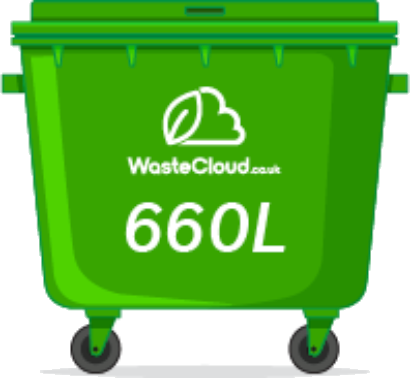
Four wheels change how a bin is used. Instead of being tipped back and dragged, a 660 litre bin is pushed on castors, usually with brakes on some of them, and it stays upright while staff lift the lid and drop bags in. That makes it quicker to fill and easier to share between several people or tenants, but it also means the bin needs a firm, level surface to stand on and a smooth route to wherever the collection vehicle stops.
The 660 is the smaller of the two four-wheeled sizes we arrange through licensed local partners. It is commonly chosen for general trade waste, mixed recycling and cardboard by businesses producing a steady, moderate volume: a restaurant, a convenience store, a primary school, a vehicle workshop or a small factory unit. Where a bin store, gate or alleyway is too tight for the 1100 litre bin, this is normally the size that fits, though measurements vary by manufacturer and are confirmed by the partner.
What a 660 replaces
A single 660 holds more than two 240 litre bins put together and takes up less room than that row would. For a business that has gradually collected a line of two-wheelers on one stream, swapping to a 660 tidies the yard, cuts the number of lifts on collection day and gives a little headroom for busy weeks. It also removes the temptation to leave bags beside full bins, which crews generally will not take and which attract vermin and complaints from neighbours. If you are unsure whether the change is worthwhile, tell us how many bins you have now and how full they are on collection day.
Ground, gradients and the collection point
Loaded four-wheeled bins are heavy to push and can run away on a slope, so the surface matters more than with smaller sizes. Tarmac, concrete or good paving is ideal; gravel, grass, steps and steep ramps are not. Check for a dropped kerb between the bin and the road. The collection crew will normally wheel the bin a short distance to the vehicle, but how far they will go, and whether they will enter a yard or building, depends on the local partner and is agreed in advance. Gate codes, keys and time restrictions are noted when you set up scheduled collections.
Streams and sensible loading
General waste should be bagged and the lid closed. Recycling goes in loose, or in clear sacks if the partner asks for them, never in black bags. Cardboard needs flattening or the bin will be full of air after six boxes; see cardboard recycling bins. Glass and food waste are seldom collected in four-wheeled bins because of their weight. Workshop wastes such as oils and fuels and tyres need their own collections. Rules requiring businesses to separate recyclables and food vary between England, Scotland and Wales, and we check which apply to your premises before recommending a set-up.
Larger volumes and one-off jobs
The natural next step is the 1100, or a second 660 on a different stream. Beyond wheelie bins, sites that fill several large bins between collections may be better served by an enclosed skip or, on industrial and distribution premises with space for a hook-loader lorry, an enclosed RORO container that is exchanged when full. Refurbishments and clear-outs should be kept out of the regular bins altogether: fixtures, furniture and strip-out debris belong in a skip or a bulky waste collection, not wedged under a bin lid. We can arrange those alongside the regular round so the bins stay free for everyday waste.
Commonly collected in 660 litre bins
- Bagged general trade waste
- Mixed paper, cans and plastic packaging
- Flattened cardboard
- Packaging film, where the partner accepts it
- Non-recyclable shop and workshop waste
Keep out of a 660
- Glass in bulk
- Food waste (use dedicated food bins)
- Oily rags, filters and workshop fluids
- Tyres
- Electrical equipment and batteries
- Building rubble and plasterboard
Not sure? See our waste types guide or ask us when you book.
Ideal for
- Restaurants and takeaways
- Convenience stores
- Primary schools
- Vehicle workshops
- Small factory units
- Multi-tenant buildings
660 Litre Bins – your questions answered
Can’t see your question? Call 0333 121 1056 or send us a message.
Does a 660 litre bin have brakes?
Four-wheeled bins are normally supplied with brakes on some of the castors, though the exact specification depends on the local partner’s stock. Apply them whenever the bin is parked, especially near a road, a slope or a doorway.
Can one person move a full 660 litre bin?
On hard, level ground one person can usually manage it, but a heavily loaded bin or any gradient calls for two. It is sensible to cover bin moving in your manual handling assessment and to site the bin so it rarely needs to travel far.
Can several businesses share one 660 litre bin?
Sharing is possible where a landlord, managing agent or one tenant holds the account and takes responsibility for what goes in. Every business still has its own duty of care, so agree in writing who may use the bin and for which waste.
Will the collection crew come into my yard for the bin?
Often they will, if the yard is open, safe and close to where the vehicle stops, but this is decided by the local partner and must be agreed beforehand. Otherwise the bin needs presenting at an agreed point before the round arrives.
Often booked with 660 Litre Bins
Need more than one service for the same project? Add them to one enquiry and we’ll coordinate them together.
Get a Quick Quote
Tell us the site postcode, the waste, the container size if you know it, and when you need it. Mention exchanges, other sites or specialist waste and we will include them. Photos of the waste and the access help.
ROROSkipHire.com is operated by Waste Cloud Ltd. Services are coordinated centrally and carried out by licensed local waste management and haulage partners across England, Scotland and Wales.